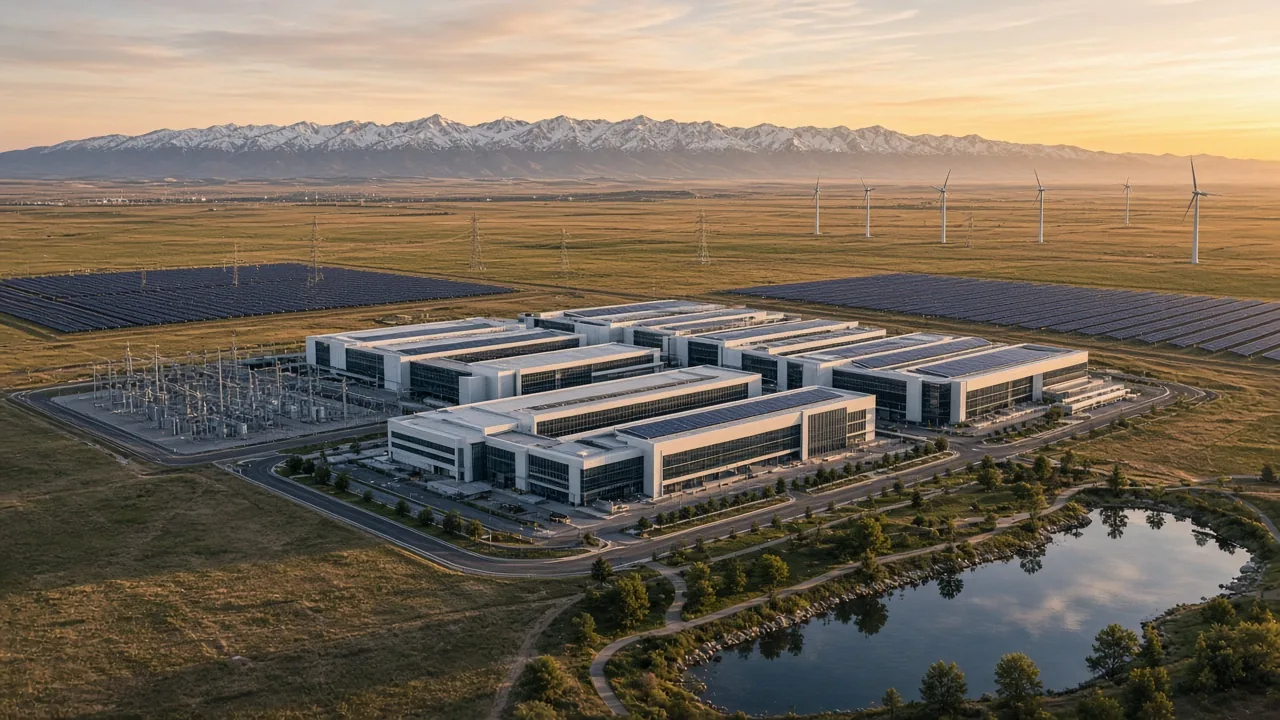
Colorado Is Losing Its High-Tech Economy. Data Centers, Built Right, Can Win It Back.
Colorado is losing its high-tech growth economy. CNBC dropped us from 11th to 25th among states for business, our lowest since 2007, and 98 companies have left or bypassed us since 2019.
We have the talent and the ideas. What we lack is the will to attract the high-tech companies that turn them into high-quality jobs and investment. Regaining that growth, and embracing it, is the defining economic task of the next decade.
Transformational, if built right
Our best recent wins, like Ursa Major, bring millions in capital investment. A single data center campus can bring billions: Meta's campus in Lebanon, Indiana is a $10 billion project. The four largest cloud companies alone are guiding about $730 billion of capital spending this year.
Yes, a finished data center employs dozens or a few hundred people, not thousands. The payoff is elsewhere: billions in construction (Meta expects more than 4,000 construction jobs at peak in Indiana), a tax base that funds schools, and grid and water upgrades paid for by private capital. Those are the things that bring the next manufacturer here.
And Colorado can win. Our cool climate lets data centers cool with outside air, Denver is a national fiber junction, Xcel already generates 52% of its Colorado power from renewables, and our workforce ranks 10th in the country.
Yet, as The Denver Post reported this weekend, we've answered with more than a dozen local moratoriums, and the legislature killed both of its 2026 data center bills.
If there's another high-tech investment of this scale within our reach, name it. I'll help champion it. Until then, let's get these deals right.
1. Solve the problems
- Rates: Without the right tariff, the cost of new plants and lines can land on households.
- Water: Evaporative cooling can strain supplies in a drought-prone state.
- Stranded assets: If the buildout slows, someone could be left paying for infrastructure nobody uses.
- Emissions: New load can delay coal retirements if clean supply isn't part of the deal.
The answer is in the deal. As a Rutgers study put it, "tariff design matters more than location."
2. Do the work
Ohio put the risk where it belongs. AEP Ohio's tariff makes new data centers pay for at least 85% of contracted capacity for up to 12 years, used or not. Regulators said it "safeguards non-data center customers."
Georgia turned load growth into lower bills. On a 3,200 MW contract this year, Georgia Power agreed households won't pay if a data center leaves early, and committed to at least $15 a month of downward pressure on typical residential bills in 2029 to 2031.
Frederick County, Maryland got a school and a training center. Its $110 million agreement includes $30 million for an elementary school, $14.5 million for workforce training and $5 million for community solar, plus an 80% cut in potable water use.
Loudoun County, Virginia cut homeowners' taxes. Data center revenue let it lower the property tax rate from $1.145 to $0.805 per $100 over a decade while funding schools, public safety and roads.
In Quincy, WA and Goodyear, AZ, Microsoft paid for the water infrastructure its cooling needed.
Colorado has the framework on the table. Xcel's proposed large-load tariff would require projects of 50 MW or more to sign 15-year contracts, pay a minimum bill of 80% of contracted capacity, post credit support and pay exit fees. The PUC has finished hearings and plans a decision hearing before year-end. The weak spot is confidential "custom contracts" that could skip those protections. On water, all four large projects now planned in Colorado use closed-loop cooling.
What a good deal looks like
- Pays its own way: long contracts, minimum bills, collateral and exit fees.
- Strengthens the grid: upgrades sized for community growth, plus new clean supply.
- Lowers bills: a stated residential benefit, publicly tracked.
- Saves water: closed-loop or air cooling and reclaimed water.
- Pays full taxes: no abatement without clawbacks.
- Builds people: apprenticeships, community college and adult education.
- Funds the community up front: a signed benefits agreement, paid before construction.
- Sited right: away from neighborhoods, with early public notice.
- Operates in daylight: public review and annual reporting.
3. Build the future
This is reform, not revolution: free markets with guardrails.
- The PUC can solve the problems. Adopt a strong large-load tariff, and hold every custom contract to the same protections with real public review.
- Local officials can do the work. Trade open-ended moratoriums for a model ordinance and a benefits agreement template.
- The 2027 legislature can build the future. Governor-elect Weiser has made data center guardrails his first legislative priority. The legislature should pair them with performance-based incentives in one bill.
It takes courage for leaders to support data centers. The easy vote is no. The right vote is yes, with terms that protect Colorado.
The next ten years will decide which Western states build the backbone of the AI economy. Colorado should solve the problems, do the work, and build the future.
Key sources: CNBC, The Denver Post, Colorado Chamber Foundation, Colorado PUC, Ohio PUCO, Georgia PSC, Rutgers, and county agreements in Frederick County and Loudoun County, linked above.
Originally published on LinkedIn